Ziqin Cao and Qiong Huang contributed equally to this work.
Abstract
Elevated blood pressure is an established risk factor for abdominal aortic aneurysm (AAA), yet traditional measures inadequately capture dynamic hemodynamic stress. This study examined the association between visit-to-visit systolic blood pressure variability (SBPV) and incident AAA, assessed whether genetic susceptibility modified this association, and explored protein-specific indirect associations. Visit-to-visit SBPV was calculated from ≥3 systolic blood pressure measurements in 189,770 UK Biobank participants with linked primary care records. Cox proportional hazards models evaluated SBPV-AAA associations, adjusting for cardiovascular risk factors and mean systolic blood pressure. Polygenic risk scores stratified genetic susceptibility. Proteomic profiling was used for exploratory protein-specific indirect-effect analyses. Over median follow-up of 10.7 years, 1,036 incident AAA cases occurred. Higher SBPV was independently associated with increased AAA risk across all metrics (all P for trend ≤0.003), with 33%–54% increased risk comparing the highest versus lowest tertile. Dose-response relationships were approximately linear (all P for non-linearity >0.05). High SBPV conferred elevated risk even with mean systolic blood pressure <130 mmHg. Participants with both high SBPV and high genetic risk had more than two-fold increased AAA risk (hazard ratio 2.07–2.28, all P<0.001). Ten circulating proteins showed FDR-significant protein-specific indirect effects in separate exploratory models, with descriptive coefficient-attenuation estimates ranging from 6.7% to 30.4%; these protein-specific estimates are non-additive and do not establish causal mediation. Associations remained robust across multiple sensitivity analyses. Higher visit-to-visit SBPV was associated with increased AAA risk, particularly among genetically susceptible individuals. These findings support SBPV as a potential AAA risk marker and warrant external validation, but do not establish that reducing SBPV would prevent AAA.
Graphical abstract
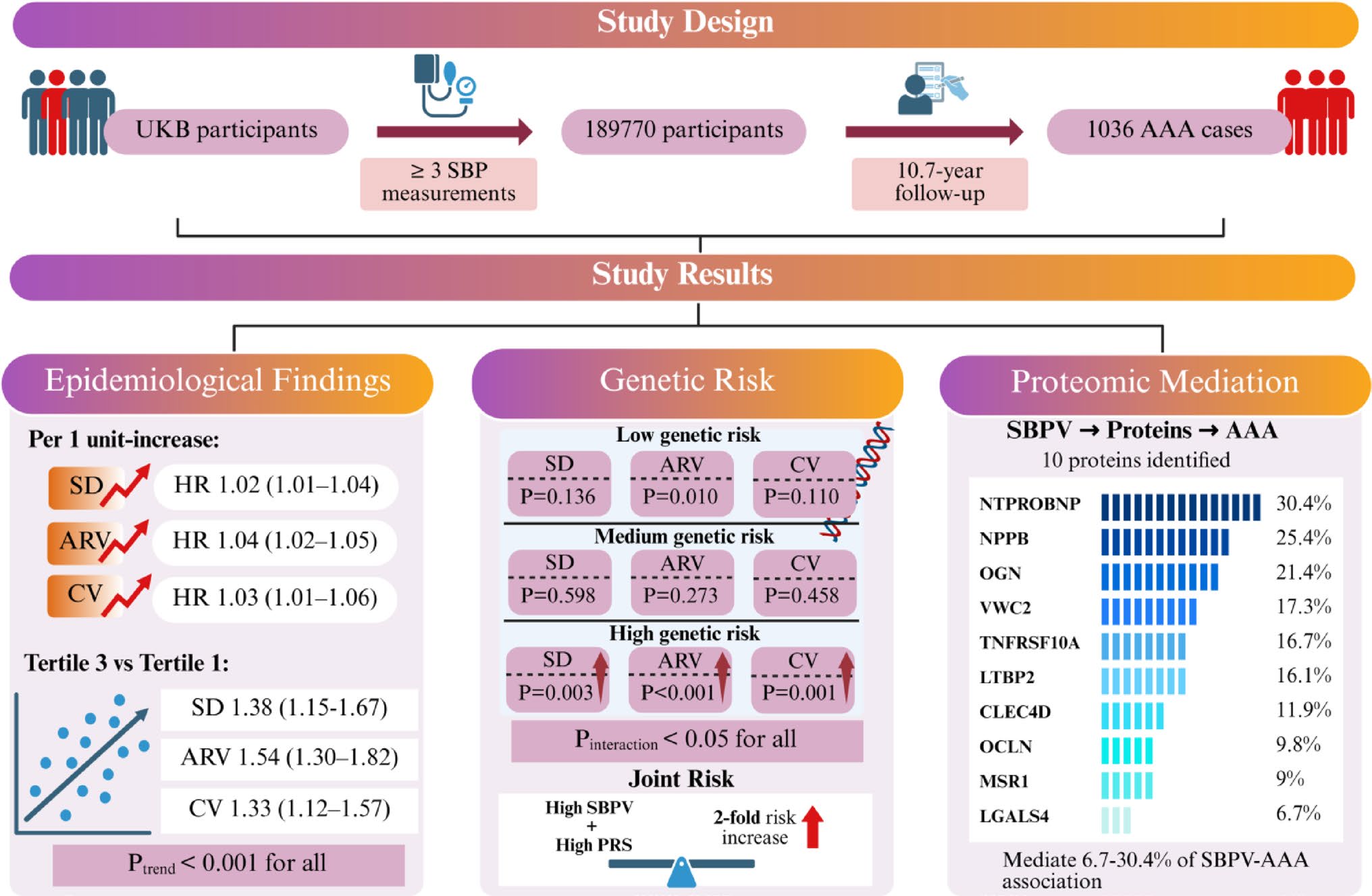
Original graphical abstract from the supplied article · View full size ↗
Study overview
- 189,770
- UK Biobank participants with at least three systolic blood pressure measurements
- 10.7 years
- Median follow-up, with 1,036 incident abdominal aortic aneurysm cases
- 33%–54%
- Higher AAA risk in the highest versus lowest SBPV tertile
Cox proportional hazards models assessed the association between visit-to-visit systolic blood pressure variability (SBPV) and incident abdominal aortic aneurysm (AAA), complemented by polygenic risk scores and proteomic profiling. Higher SBPV remained associated with greater AAA risk after adjustment for mean systolic blood pressure and cardiovascular risk factors.
Participants with both high SBPV and high genetic risk had more than twice the AAA risk of the reference group (HR 2.07–2.28). Higher SBPV was also associated with increased risk among participants with mean systolic blood pressure below 130 mmHg.
In this observational study, ten proteins showed FDR-significant protein-specific indirect effects in separate exploratory models. These estimates are non-additive and do not establish causal mediation. The findings do not establish that reducing SBPV would prevent AAA.
Keywords
Hypertension · Blood pressure variability · Abdominal aortic aneurysm · Polygenic risk score · Proteomic analysis · Prevention
Read the article
Read the original PDF for the complete methods, results, discussion, tables, figures and references.
Read PDF on this page
About this article
Cite this article
Cao, Z., Huang, Q., Zeng, Y. et al. Systolic blood pressure variability as a risk factor for abdominal aortic aneurysm: a prospective cohort study with genomic and proteomic profiling. Eur J Epidemiol (2026). https://doi.org/10.1007/s10654-026-01459-2